One of the important metrics used to define the burden of disease was developed by WHO. DALY, or Disability-Adjusted Life Years, quantifies the difference between the actual health status of a population and an ideal situation where all individuals live long lives free of disease, free of disability. It measures not just mortality but also morbidity, and it's a measurement based on time.
DALY = YLL + YLD
This equation expresses the years of life lost (YLL) to premature death, and concurrently factors in years of healthy life lost because of years lived with a disability (YLD). This allows for the impact of disease or risk factor to be determined in that one DALY is equivalent to one lost year of healthy life.
Given that the previous post took me 20 minutes to write but two hours to upload, I've come up with a unit of measurement to measure the burden of slow internet for an aid worker living in a developing country. Life lost to premature death, eg due to inhaling particulate matter laden with bacteria making Phnom Penh air worse than Bangkok's smog, and healthy life lost because of years surfing and uploading blog posts on slow internet.
SIALY = YLL + YLSI
(Slow internet adjusted life years) = (Years of Life Lost) + (Years living with Slow Internet)
Mind you, my slow high-speed connection in this Kingdom's capital is not as bad as some of the screaming fast Commodore 64 connections that other colleagues have to contend with. So kudos to the best of you who can produce creative pieces of writing amid these uninspiring conditions. I think I just grayed three more hairs. :-(
.
September 19, 2009
slow high-speed internet woes in Cambodia


September 17, 2009
Pchum Ben, to remember the ancestors
 This is such a great photo, shared by Metro Cafe.
It is Pchum Ben in Cambodia, one of the biggest Buddhist holidays in which people visit the pagodas and bring offerings in remembrance of their ancestors. Once again there is a mass exodus from the city as the Khmer go to their provinces to visit their families, and foreigners take advantage of the many days off to flee the country.
Pchum Ben is similar to the Christians' All Saints' Day. This ritual used to be an ancient Celtic celebration called Samhain. Attempting to suppress these pagan traditions the Catholic Church created All Saints' Day (All Hallows Day) in the 7th century to christianise the event.
Other cultures have rituals for remembering their dead around this same time of year too:
- the Pasola Festival in Sumba, an island east of Bali
- Dia de los Muertos (Day of the Dead) in Mexico
- Dia de los ñatitas (Day of the Skulls) in Bolivia
- Brazil celebrates Finados (Day of the Dead)
- Araw ng mga Patay (Day of the Dead) in the Philippines
- O-bon (お盆) or only Bon (盆), a Buddhist holiday in Japan
- Hankawi (한가위,中秋节) is Korea's traditional day of remembrance of their dead
- Ghost month (鬼月) in China
September 05, 2009
Sunset on the Mekong
 It's been a while since we've seen a sunset here. After the brief lull in the rains last month, September came storming in with brilliant downpours and the energy-sapping intermittent drizzling all day long. In some provinces south and west of Phnom Penh these downpours made up for the drought. Unfortunately there was so much sudden deluge that up to 2m have been recorded in some villages around the country, and flash floods have taken about a dozen lives.
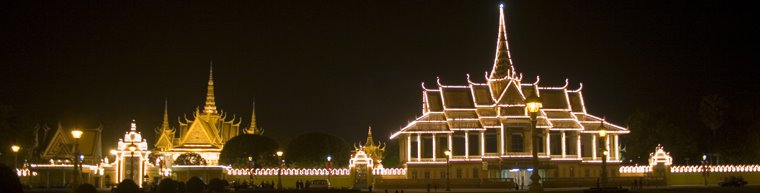
This photo above of the Phnom Penh skyline was taken from the peninsula before the rainy season started. That is the royal palace and royal viewing stage (for the November boat races during the Water Festival, or Bon Om Touk).
The riverfront is getting a massive makeover. Actually open areas around the city are getting a fantastic makeover. Khmers love it, these parks are filled every morning at the freakin' crack of dawn with groups assembling for exercises. It's the popular hangout for inexpensive dates, loitering, families taking their kids out to fly kites, getting some street food and gaping at the water acrobatics at the fountains. Aren't these colors brilliant?

September 02, 2009
Dramatic skies in rainy season

 There was a brief lull in the rainy season as usual this past August. But the rains are back in full swing again. The Mekong and Tonlé Sap Rivers are swollen rich from the monsoons up north. The Tonlé Sap River, which meets the Mekong towards the south of Phnom Penh in front of the Royal Palace, reversed directions about three or four times already, but volume and flow reversal has been weak due to dam building in China and Laos, north of Cambodia.
(In dry season flow in the Tonlé Sap River is southeast to the Mekong River. But with high volume on the Mekong during wet season it backs up the Tonlé Sap River, causing it to reverse its flow and fills the Tonlé Sap Lake in the northwest section of the country. This is one of the largest freshwater lakes in Asia and is Cambodia's most prominent geographic feature.)
We have our very first skyscraper, prominent above in the first picture just to the right of Wat Phnom, against the dramatic rain clouds. The first two photos are of the Phnom Penh skyline from Maxine's Bar (or "Snowy's" to some) across the Japanese bridge, on the peninsula. The others are around our neighborhood (all were taken by Keith Kelly). Hard to capture lightning on film eh?


July 27, 2009
our resident tukei gecko
 Isn't Fred the cutest tukei gecko ever?? Except he's a SHE! LOL! Just saw her little ones yesterday, they're feisty like mommy!
Fred is about 6inches around her tummy, 10inches long to the end of her tail. She's been a regular at our place for years. Or should I say, WE've been regulars at HER place for years LOL!
.
July 22, 2009
Celestial dance of 22 July 2009
A dismal overcast day spawns in the Kingdom. The mighty Mekong bucks and swells with all the world's rage. Celestial beings roar.
Across the land village radios quiver with the news: the Eye of God cometh. Today a dark day falls. None shall be spared.
Humans and fortune tellers and witches scurry about their paltry rituals and offerings to stave the impending doom. But the cauldron of the heavens boils and bubbles. In just moments the essence of wrath will descend upon earth to end this corrupt age of Kali. Lesser clouds sent by a kindly small (unknown) Hindu god for Cambodia's meager comfort cower as the lunar transit arcs straight into the solar spectrum.
om shanti..... Om Shanti.... OM NAMAHO SHIVA!!
[looks to see if you, reader, are still watching....]
Well. Thunderclouds rage also in my thoughts. There goes my view of the solar eclipse. Would be nice to see the arc of the cosmos hurtling us towards our destruction, at least.
[sulks. chucks a used tissue over the balcony... and the used tissue chucked over the rail blows into my downstairs neighbor's balcony.]
[a small smile escapes.] This day may yet improve. :-)
---- update at 12:05pm, after the eclipse:
Our six and a half minutes of solar eclipse was watched by many of my friends, thanks to my news flashes on Facebook. Here below is a picture taken by Dave Coolio, since for part of those six minutes I was called into someone's office for a minor query. :-(
Also why Dave felt the need to point out the obvious in the photo is beyond me. .
.
July 20, 2009
California plates in the Penh
 California DMV yoohoo! Anyone file missing Land Cruisers with plates 2d8514 or 4USN291 lately? They're in Cambodia LOL! (Took this shot two months or so ago and forgot to post them, though I did tweet it!)
.
Traffic rules? What traffic rules?
 Only four traffic laws broken in this pic LOL (unless you count all the helmet-less heads on two wheels);
2. going the wrong way, which I suppose is subjective in this country;
3. mobile stuck to the head while driving a moto (although I guess this isn't a law in Cambodia);
4. same guy who doesn't have a helmet while yakking on his mobile is also missing his mirrors.
Did I miss any others?
I love the very specific methods for plowing straight into oncoming traffic: make eye contact and you lose the right of way. LOL! No helmet, talking on the mobile, and obviously the point of rearview mirrors is lost on this fellow.
.
July 18, 2009
Opposition views not allowed
In celebration of Cambodia's thorough crackdown on opposition views, I'd love to take up Maggie Lamb's challenge on Facebook for all of us to violate Articles 62 and 63 in the Cambodian criminal code at the same time.
Robert Carmichael in the Asia Media Forum lists some recent actions against opposition officials and members of the press, which does not include the defamation case against the Cambodia Daily:
One editor of a newspaper affiliated with the opposition Sam Rainsy Party (SRP) is now serving a one-year jail term for publishing a story the government objected to. The publisher of another newspaper, ‘Moneaksekar Khmer’, was told this week he would be sued and could go to jail after publishing a series of articles allegedly designed to incite conflict between government ministers.That the government beelines for the courts rather than counter criticisms via more palatable channels such as rebuttal pieces, propaganda speeches and using more of the widely popular comedy skits as they did a few weeks ago, is truly curious. See one of the videos here: Khmer Media Watch.On the political front, two opposition MPs are being sued by senior officials of the ruling party for defamation after having their immunity stripped by the lower house. Their lawyer recently quit their cases and the SRP and crossed over to the ruling Cambodian People’s Party (CPP) after being told he would be sued.
Two other opposition MPs have been told they could have their immunity taken away too. Two non-government organisations have also received legal threats.
Oh and WWF joins the ranks of Unfavored NGO Status in Cambodia for releasing scientific data on the state of the Mekong River dolphins (the species is all but functionally extinct). To further add to the comic relief, Global Witness recently urged the UK to revoke PM Hun Sen’s visa ahead of a planned visit to the country to see his son graduate.
Wonder how the crackdown will be managed on the internet, as it will inevitably do. There are a growing number of critical voices across the various social networks...
.
how tourists should not treat the natives
 D and I were sitting in a restaurant nowhere near the tourist track when some kids were dropped off by a tuk tuk outside. As they wandered a few feet, gawking about with lonely planets and maps in their hands-- very comically lost-- a rude blog post title popped to mind: "You too can look .....". We stepped out to snag some quick shots, when these guys turned the tables on us. They waved and smiled really big, the kind you save for retarded people, probably thinking we were natives taking photos of foreigners. We took off before they could start talking really loud English at us.
I have never been looked at by a white person like this. My immersion in Cambodia is complete.
.
July 01, 2009
Preah Vihear UNESCO World Heritage Site
Since D was here, we thought we'd take that trip to the border temple that Keith and I have wanted to see. Thailand tends to have dispute with UNESCO over the World Heritage status of the temple and award of the grounds to Cambodia (it's a disputed land area on the border) whenever they are having domestic political turmoil. It is pre-Angkorian, so it predates Angkor Wat. Because it's a conflict area restoration has been on hold and there are very few foreigners who come to this mountaintop ruin. You essentially put yourself between the Cambodian troops and the Thais when you visit this place. Preah Vihear is 4hrs from Siem Reap (Angkor Wat), which is 5hrs from Phnom Penh. About an hour out of Siem Reap the paved road ends. If it's raining, your driver better be damn good! Even SUVs are useless when you can't maneuver the car. It is almost like driving in deep snow.
 Thankfully there wasn't any rain when we arrived at Preah Vihear. It's a steep climb up a now-paved road on this mountain, so you need a four-wheel drive. Needless to say, it isn't smooth. I still have some bruises. At one point there were about nine of us crammed into the bed of the pickup truck. D and I held on for dear life smack in the middle of the bed while seasoned soldiers sat on the edge casually hanging on, laughing at us.
At the top, you're hard-pressed to find signs of conflict. The ruins are overrun by soldiers- surreal. There are Khmer tourists wandering about like the place hadn't been pelted with shells only recently. No foreigners (namely, no busloads of package tourists from Japan, Korea, China, and Europe), so that was VERY nice! Hmm.. Look at that concentrated gray coming out of the side of my head over the parietal lobe. Maybe I did too much math in grad school [scratches head].
That is Preah Vihear town below. Follow that road right (southeast?) and it leads to Ang Long Veng, a very historic city where Pol Pot also is buried. There's nothing out in these parts, so accommodations are slim and very bare / basic.
 Some of the soldiers look like little kids. They aren't allowed off the mountain. When we came back down they searched our vehicle for stowaways.


 See this guy's grenade? I pointed at it, was thinking that pin looks could get popped easily off. But it is ok, I was told it is secure. There is a rubber band holding it in, and he handed it to me. Heavy. The rubber band? You know when those things get old and start to dry up brittle? I thought we'd best leave soon..
 Long day, but a great time. :-) If you can make it out here while the troops are still around it's a great time. They're awesome hosts. They even let you hold their weapons. Strange to be handling these loaded guns, rockets, grenades etc. At the end you give the soldiers some small cash so they can buy cigarettes.
June 30, 2009
around the 'hood with a visiting friend
 Here's my street, we live a block off the Royal Palace. It's everyday scenes like this that you never bother to take photos of until a friend comes along and captures everything you don't blink twice over anymore. To the left is a tuk-tuk, riding the line to his left and back is what they call here a cyclo, and practically most people travel by some form of motorbike here.
 Every day monks walk around the neighborhood collecting alms (this is one of the stores downstairs). Since the Khmer Rouge decimated the elder ranks, the religion's influence has not gained its previous legitimacy and credibility. Respect for monks and the solidarity they fostered before the conflict era have been largely eroded.
 Time for some tours around the city! This is what I get when a journalist friend is visiting. LOTS of photos of me. And yes, I know these huge sunglasses are horrible fashion bombs, but they're great for tuk-tuk riding cuz short of goggles they keep everything out of your eyes!
 The Independence Monument Plaza, view from Sothearos Blvd. See the cranes in the background? Phnom Penh is under constant construction. sigh.
 D was an inspiration to me long ago with her wanderlust. Everyone back then thought she was a nut (me too, secretly!). Of course now we both envy our friends the stability of life and family and community when our lives are anything but. But connecting in different parts of the globe once in a while brings us back to what matters and what brought us out on these paths in the first place.
 In a city growing up so fast, these bicycle vendors selling kids' toys brings memories of olden days. They're still numerous on the city streets, particularly where people like to gather at night in the new plazas.
 Those of you who saw City of Ghosts (2002) with Matt Dillon might recognize this guy. Ian 'Snowy' Woodford is an old fixture in the Phnom Penh 'hoods from the UNTAC days. He's now running a bar / gallery across the Tonle River from the city.
 The Phnom Penh skyline! Naturally you must have a healthy imagination to see it ;-) D and I rented a boat ($16/2hrs) and cruised the Tonle River. Brought a bottle of wine and some desserts. I always forget to look up at the night sky whenever I'm in cities. PP is sufficiently small that you can get a glimpse of some stars. But out on the river- wow.
April 11, 2009
Where is Khmer culture going?
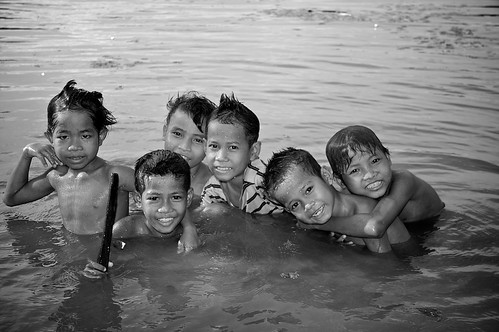
With such rapid pace of progress, Cambodia eagerly embraces a bright future. That's the upside. What's disheartening is that it's a future that chases inspiration externally-- specifically from the West, while rejecting its own rich legacy and heritage.
Silence about the Khmer Rouge period
With the KR trials commencing, spotlight is on the reaction of the Khmer population. But collective suppression of this period in history is the prevailing practice. Even the international community avoids the issue: aid funding for mental health has been nil, despite numerous requests and rampant indication of need. What little dialogue is had about tribunal activities is mostly aimed at foreigners and international scholars, researchers, interns.
Khmer kids have not an inkling of the import of the Khmer Rouge period. It's not taught in school, barely mentioned in the home, and no discourse is had in the public sphere. To be ignorant of it is one thing, but I was shocked on arrival that my new friends flat-out deny these atrocities ever even occurred. They say it's just old people talking to scare them... Here Seth Mydans reports on how Cambodia's youth know little about the Khmer Rouge atrocities (NYT):
Some older people get so upset at their children for not believing that they say, ‘I wish the Khmer Rouge time would happen again; then you’d believe it,’ Mr. Ty Leap said.
Thought leaders, influencers and the professional cadres were largely eliminated during the KR period, true. But a complete dismantling of the Khmer social infrastructure is reinforced by this large-scale avoidance of the topic. It is a rift, chasm, disconnect that winds and rends through the entire fabric of Khmer society.
Frayed social networks
For thousands of years Buddhism has been the pillar of social cohesion-- a vanguard of Khmer culture and moral authority in matters of social and even political affairs. But the abbots' and monks' relevance has deteriorated, largely from decimation of the top ranks of the Buddhist order. This left a fragmented social system and a void, at a time it is most needed.
We're witnessing the extinction of many art forms, from music to fine arts, with little local advocacy. Such cultural expressions usually boom after conflict periods; it is part of a society's healing process to document memories. But the arts are unsupported, even from the royal family, many of whom including the King are gifted artists. This point is very telling by itself. The royal family does not reside in-country, and the King is (was?) a dance professor in France who spends little of his life here. What better way to convey the message to your people that Khmer culture is sub-par than to abandon the very channels for social expression.
My colleague's father was a renowned painter prior to the Khmer Rouge period, and his works hang in the National Museum in Phnom Penh. Thoroughly impressed, K requested an interview. Her response? His art is so old, why would he be interested in it when she can introduce him to more exciting contemporary artists instead. She was sure to add that good artists have had training in the West or from Westerners-- her father "only" knew Angkorian style.
These are just a few instances of the absence of pride among Khmer for anything Cambodian.
Foreigners' role in advocating Khmer culture
The generations after the KR only ever knew to aspire to the whims of endless armies of westerners bringing our ideas to them, experimenting on a societal scale at will and for the most part unchecked. Khmers are conditioned to worship the power of the dollar. They're exposed to and want the excesses they see on the pirated Hollywood blockbusters: fast cars, fast money, throwaway relationships, soundbyte politics and a consumption lifestyle-- all a complete flip of the essence of Cambodian philosophy towards life. China, India, Thailand, etc, have all chosen to embrace modernity. But their quest for progress is continuously negotiated against the substance of their cultural identity. Khmers seem not to have this.
Instead of coming from within, foreigners (for lack of elder Khmer mentors) are showing the youth what's cool about their own Khmer culture. Through the filters of foreign taste, Khmer are learning to appreciate the finer elements of their own traditions. The context is displaced, disconnected, inorganic.
For me, growing up in the US, I was taught the essence of my Filipino heritage in the home, and learned my new country's cultural nuances through social situations. Most of us have the luxury of this foundation from which to forge our identity, whichever direction that may go. I reject some Filipino and American traditions on the basis that I had grasp of the context. Cambodian kids are given little context from which to move forward.
So what's in store for Cambodian culture?
Mentors from within the country are still few relative to the boomer population post-KR, but this cadre is steadily growing, (thankfully) embracing their Khmer identity and taking the lead to advocate for it. Ever so slowly, foreigner guidance will give way to this new generation of elders. But it'll take entire lifetimes. In the meantime, a cultural schizophrenia guides the direction of progress in Cambodia...
April 04, 2009
Irrawady dolphins in the Mekong

 Only four (five?) groups of freshwater dolphins are left in the world, mainly due to habitat loss and hunting-- two in S. America and three in Asia. Here in Kratie, Cambodia, there are between 20 to less than 100 of the Irrawady dolphins. With such low numbers they are functionally extinct. They come to the Kratie area of the Mekong during the dry season (practically the only attraction there) and head up to Myanmar for the rest of the year.
.


April 01, 2009
View from shotgun
I don't like riding in the back of the SUV like I have a chauffeur, but I also really hate traveling shotgun here for many reasons. The probability is high for anyone living here for being in an accident. Here are some photos why: Roads in developing countries aren't the safest, so you can't sit back and relax in the car. Almost every trip I make I pass an accident. On the national roads it's even worse. Against your better sense of humanity, foreigners are advised never to stop and help, even if you're with a local who can communicate. You can easily take the heat for the accident even if you arrive long after the event. And without an underlying structure of order, mob justice prevails. You're on your own if any danger comes to you from being a good samaritan.
 Motorbikes are used to transport anything and everything. These guys are each carrying two beds strapped precariously to their motos, traveling about 35km/hr for about 3 hours to Phnom Penh.
 Sights like these are common and, likelier than not, no matter how high a vehicle is packed, there are people sitting (or sleeping) on top of the cargo.
March 12, 2009
Day Trip from Phnom Penh to Phnom Oudong
This trip was a 50minute motorbike ride to the outskirts of Phnom Penh on a very hot Sunday. This is a typical panoramic view of Cambodia in the North-South region Siem Reap - Sihanoukville: flat as a pancake dry and dotted with palm and coconut trees, etc. Elevations are revered spots and wats (pagodas) are usually constructed on top of them.


 These images of Buddha in various interpretations are not for idolising, such as Christians worship the images of the God. These images aim to inspire the appropriate mode of behaviour towards the personal achievement of enlightenment. It is an admired philosophy, especially during these modern fast-paced times, but its lack of appreciation for personal gains contributes to the detriment of Asian society (values?) in an age of materialism and the pursuit of wealth.
 I have no idea what kind of turtles these are, but a lot of them are classified 'threatened' in Cambodia. We were taken once to a restaurant in Kampot Province, where the walls were lined with WWF and conservancy posters. Obviously it's illegal to hunt those animals on the posters, but enforcement capacity is low. They were the menu offerings, but only hush hush. If officials came through the door the establishment is upholding the law.
 No shortage of cutesy shots in the third world. Sadly this is exploited and children are sometimes harmed in order to garner more sympathy and thus more money from foreigners.
 At wats around the country there are soothsayers who will read palms, feet, sticks, and tea leaves. Philosophies about fate and destiny are major factors why the region has not lived to its full capacity in the past several centuries compared to the West.
 This woman makes 3 baskets in one day. Then sells each basket for 1000 Riel (25 cents) for a small one, or 3000 Riel (75 cents) for a big one the size of a cantaloupe. I can never look at the handicrafts in a Pier1 store ever again, since coming out to Asia.
 The prize part of a crab is the fat inside the shell. Here they are sold by a vendor at the market. These are river crabs, small enough to fit nicely in a child's hand. The shell / fat is sold for 600 Riel (~24 cents) and the whole crab for 1000 Riel (25 cents).

 There were probably five mosques on the way to Oudong from Phnom Penh, which surprised us. Muslims make up 10% of Cambodia's population, the largest group after Buddhists, but they're largely concentrated in Kampot and Kampong Cham (Cham is the Khmer word for Muslim). Saudi Arabia finances the building of mosques here. Their presence has been slowly increasing, since the finding of oil off Cambodia's coasts.
All photos from Keith A Kelly's photostream.


